
Georgetown DC Real Estate
Homes for Sale Near M Street, Wisconsin Avenue & the Potomac Waterfront. From Marc Dosik & the Fed City Team, your DC real estate experts.
Search Georgetown Homes
Living in Georgetown
Dining & Retail
Martin's Tavern (1933, where JFK proposed to Jackie in Booth 3), Clyde's of Georgetown, Café Milano, and 1789 Restaurant anchor the dining scene. The Cady's Alley design district along south M Street holds Waterworks, Design Within Reach, and Bulthaup. Book Hill on upper Wisconsin Avenue adds about 40 independent boutique shops.
Parks & Recreation
Georgetown Waterfront Park (a National Park unit) runs from 31st Street to Key Bridge along the Potomac. The C&O Canal towpath is one of DC's most-used jogging and biking routes. Montrose Park (16 acres on R Street), Dumbarton Oaks Gardens, Volta Park, and Rose Park round out the green space.
Transit & Commute
Georgetown has no Metro station — a real factor in daily life. Foggy Bottom-GWU (Blue/Orange/Silver) is about a 15-minute walk from M & Wisconsin, and Rosslyn sits across Key Bridge. Most residents rely on a mix of WMATA Metrobus, Capital Bikeshare, rideshare, and walking. Driving is straightforward off-peak, brutal on weekends.
What makes Georgetown historic.
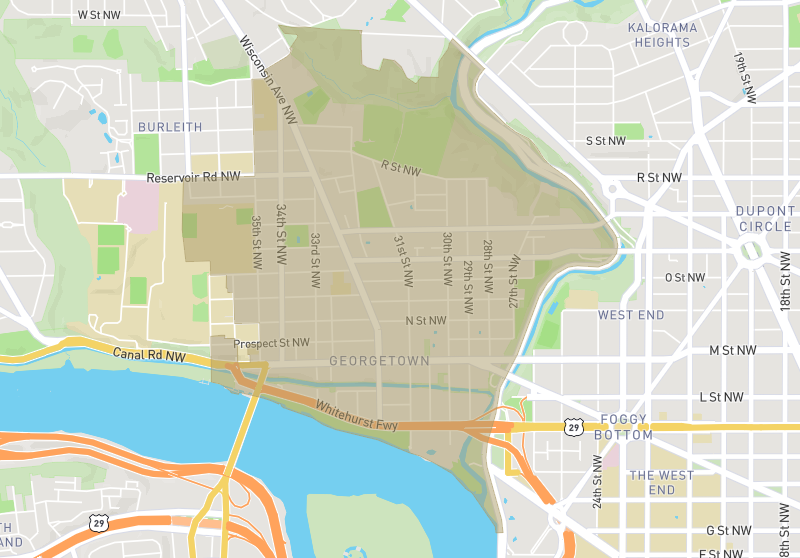
Georgetown predates Washington, DC. The Maryland legislature authorized its founding in 1751 as a tobacco port, four decades before the federal city was laid out, and it remained an independently incorporated town until Congress folded it into DC in 1871. That history is visible on every block. The Old Stone House on M Street (1765) is the oldest unchanged building in Washington. Tudor Place (1816) was designed by William Thornton, the architect of the U.S. Capitol. Dumbarton House dates to 1799.
The neighborhood is a designated National Historic Landmark District — the entire area from the Potomac River up to Whitehaven Parkway, between Rock Creek and Glover Park. Almost any change visible from a public sidewalk goes through formal review. Georgetown University, founded in 1789 as the country's oldest Catholic university, anchors the western edge along 37th Street and shapes the rhythm of the place.
One fact surprises almost every out-of-town buyer: there is no Metro station. The Foggy Bottom-GWU station is about a 15-minute walk; Rosslyn sits across Key Bridge. What makes Georgetown work despite that is everything else — the walkable commercial spines of M Street and Wisconsin Avenue, the C&O Canal towpath, the Waterfront Park, embassies, and hundreds of independently owned shops and restaurants in a tightly built environment where you can do a week's errands on foot.
Explore Georgetown Block by Block
East Village
East of Wisconsin Avenue toward Rock Creek Park. The more prestigious side — bigger lots, more mansions, embassy-row energy, and home to landmarks like Tudor Place, Dumbarton Oaks, and Evermay. Trophy mansions on R Street, N Street, and S Street regularly clear $8M to $15M+. Quieter and more residential than the West Village.
West Village
West of Wisconsin Avenue toward the university. Denser, with more student rentals, more rowhomes cut into apartments, and the Cady's Alley design district along the southern edge. Per-square-foot pricing often comes in slightly below the East Village, making it a more accessible entry point for buyers who want Georgetown architecture without the East Village price premium.
The Waterfront
South of M Street, closer to the canal and the Potomac. Dominated by condos — Washington Harbour, 3303 Water Street, the Flour Mill, and Papermill. River-view premiums are real, but so is the FEMA-designated floodplain. Insurance, elevation certificates, and flood mitigation are real considerations for any buyer in this zone.
Georgetown Real Estate Market
$1.8M–$3.5M
Typical Rowhome Range
$500K–$1.5M+
Condo Range
~$760
Median Price / Sq Ft
~12%
YoY Appreciation
Most Georgetown buyers expect Federal-period architecture, but the reality is more mixed. About 88% of Georgetown's existing housing stock was built after 1870, which means the dominant style is actually late-Victorian — Queen Anne, Italianate, Romanesque, Classical Revival — with a famous but minority Federal core. Either way, these are some of the most architecturally significant rowhouses in the country.
Typical Georgetown rowhomes range from $1.8M to $3.5M depending on size, condition, location, and parking. Turnkey homes in better blocks of the East Village run $4M to $7M. Trophy mansions on R Street, N Street, S Street, and the prime cobblestoned blocks of P and Q Street regularly clear $8M to $15M+. The 3307 N Street house — where John and Jacqueline Kennedy lived before the White House — sits on one of the neighborhood's most photographed blocks.
Condos range broadly. Entry-level studios and one-bedrooms in older buildings start in the high $500Ks. A typical two-bedroom in a well-located building lists around $1M to $1.5M. Larger units in waterfront luxury buildings — 3303 Water Street, the Flour Mill, Washington Harbour — range from $1.5M to $5M+, with penthouses occasionally trading above $5M. Buyers in the waterfront zone should review elevation certificates and flood-insurance requirements carefully.
For sellers preparing a Georgetown home for market, our We Pay to Fix Your Home program covers renovation costs upfront so you can compete with fully renovated listings. We also handle estate sales for inherited Georgetown rowhouses that may need substantial work before going to market.
Georgetown agents who know the historic district inside and out.

Our office is at 843 Upshur Street NW in Petworth, and we've closed Georgetown deals across all four sub-areas — East Village, West Village, the waterfront, and Book Hill. Marc Dosik has been selling real estate in DC, Maryland, and Virginia since 1998, and our agents know which blocks have parking pads, which rowhouses have come through the OGB process recently, and which condo buildings are well-managed.
For Buyers
If you're buying a Georgetown house that needs work, we'll help you understand which renovations are likely to be approved and which will run into trouble at the Old Georgetown Board before you make an offer. We bring a network of contractors and architects who know how to navigate OGB submissions. We also help first-time buyers access up to $17,500 in DC down payment assistance through grant programs most buyers don't know exist.
For Sellers
Our We Pay to Fix Your Home program is especially relevant in Georgetown, where buyers expect a polished presentation and where renovation work runs more complex than elsewhere. We cover renovation costs upfront and you sell at a higher price with $0 out of pocket.
Georgetown is protected by the Old Georgetown Act of 1950, which adds a federal review layer on top of DC's historic preservation board for any exterior change.
Any exterior change visible from a public way — windows, doors, paint colors, signage, fences, additions, even HVAC condenser placement — has to be reviewed by the Old Georgetown Board, which advises the U.S. Commission of Fine Arts. In practice, renovation budgets and timelines for Georgetown homes typically run 30% to 50% higher than equivalent non-historic homes elsewhere in DC. Our We Pay to Fix Your Home program covers compliant updates upfront so you can compete with fully renovated listings without spending money out of pocket.
Georgetown Real Estate FAQs
What is the typical price range for a rowhome in Georgetown DC?
Most Georgetown rowhomes sell in the $1.8M to $3.5M range. Turnkey, well-located homes in the East Village run $4M to $7M. Trophy mansions on R Street, N Street, and around Dumbarton can reach $8M to $15M+. Condos range from the high $500Ks for studios to $1.5M+ for two-bedrooms in luxury buildings, with waterfront penthouses occasionally exceeding $5M.
Why is there no Metro station in Georgetown?
The short answer is a combination of 1970s-era political opposition from neighborhood groups and the topography of the area. The closest stations are Foggy Bottom-GWU (Blue/Orange/Silver), about a 15-minute walk from M & Wisconsin, and Rosslyn across Key Bridge in Arlington. Most Georgetown residents rely on a mix of walking, Metrobus, Capital Bikeshare, rideshare, and personal vehicles.
What is the Old Georgetown Act and how does it affect renovations?
Public Law 81-808, passed in 1950, requires that any exterior change visible from a public way in Georgetown be reviewed by the Old Georgetown Board, which advises the U.S. Commission of Fine Arts. This is on top of DC's standard Historic Preservation Review Board review. In practice, it adds time and cost to nearly any exterior project — windows, doors, repointing, additions, paint colors, signage. Buyers should expect renovation budgets and timelines roughly 30% to 50% higher than non-historic DC neighborhoods.
Is Georgetown a good investment?
Georgetown has shown remarkable price stability. Even in 2025, when broader DC absorbed roughly 33% more inventory due to federal workforce reductions, Georgetown medians held at $1.7M-$1.8M. The combination of National Historic Landmark protection, limited new development, a strong international and high-net-worth buyer pool, and roughly 20% cash-buyer participation makes Georgetown one of the more recession-resilient submarkets in DC.
What are the best blocks to buy on in Georgetown?
It depends on priorities. For trophy mansions and quiet residential character, the East Village blocks of R Street, S Street, and around Dumbarton Place are unmatched. For walkability to dining and retail, anywhere within a few blocks of M & Wisconsin works. For waterfront condo living, the K Street and Water Street corridor — Washington Harbour, 3303 Water, the Flour Mill, Papermill. For relative value, the West Village blocks closer to the university, or Burleith and Glover Park just north.
What is the parking situation in Georgetown?
Difficult. Many Federal-era rowhouses predate cars entirely and have no off-street parking. Residential Permit Parking (RPP) zones limit but do not eliminate competition. Off-street parking — a pad, driveway, garage, or rear-alley spot — is a major value-add and typically adds $50,000 to $100,000+ to a Georgetown rowhouse. We strongly advise buyers to weigh parking access carefully.
Get in Touch
Ready to buy or sell in Georgetown? Call the Fed City Team today.
Want the full market report for Georgetown?
We want to ensure that you have all the information needed to make the best decisions when it comes to your home goals. When you enter your info below you will get instant access to the area's latest market report, complete with sales and demographic trends.