
Baltimore MD Real Estate
Homes for Sale Near the Inner Harbor, Federal Hill & Roland Park. From Marc Dosik & the Fed City Team, your Maryland real estate experts.
Search Baltimore Homes
Living in Baltimore
Dining & Daily Life
Baltimore's restaurant scene runs from Charleston and Cinghiale at the high end to Faidley's crab cakes at Lexington Market and the Old Bay-spiced steamed crab feasts at Costas Inn and LP Steamers. Public markets — Lexington, Cross Street, Broadway, and Hollins — anchor their neighborhoods, while Hampden, Federal Hill, and Mount Vernon each carry deep independent restaurant benches. Visit Baltimore tracks the citywide events calendar.
Parks & Outdoors
Druid Hill Park is one of the largest urban parks in the country, with the Maryland Zoo and miles of trails. Patterson Park anchors the eastern side. The Inner Harbor connects Fells Point, Harbor East, Federal Hill, and Locust Point with a continuous waterfront path. Fort McHenry sits on a peninsula in the southern harbor. The Gwynns Falls and Jones Falls trails run from downtown to the city's edges.
Transit & Commute
The MARC Penn Line connects Baltimore Penn Station to Union Station in DC in 45 to 60 minutes, with frequent peak-hour service. Amtrak's Northeast Corridor adds direct service to Philadelphia, New York, and Boston. Within Baltimore, the Light Rail runs to BWI Airport, the Metro Subway runs east-west, and the Charm City Circulator provides free shuttle service through the central city.
What makes Baltimore distinct.
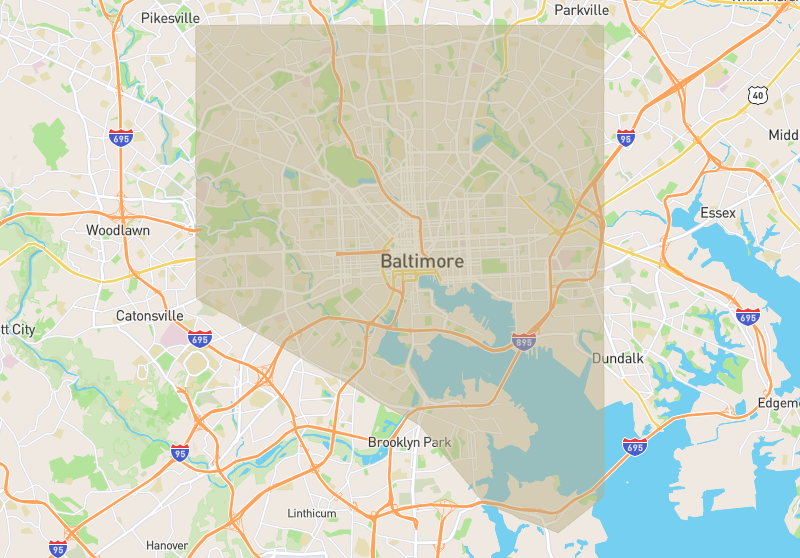
Baltimore is a city of rowhomes. Roughly 80 percent of the residential housing stock consists of rowhomes, most built between 1850 and 1930, in styles ranging from federal-era brick rowhouses to Italianate, Second Empire, and Edwardian designs. The variety is remarkable: marble steps in Locust Point, formstone facades in Highlandtown, painted screens in Hampden, three-bay Italianates in Reservoir Hill, and grand four-story rowhouses in Mount Vernon.
The economic base has shifted dramatically over the past 50 years. Steel, shipbuilding, and heavy manufacturing have been replaced by healthcare, education, defense, and federal employment. Johns Hopkins University and Hospital are the largest single employer in Maryland with more than 50,000 employees. The University of Maryland Medical Center, the Social Security Administration, the NSA at Fort Meade, and a dense cluster of biotech firms anchor the broader economy.
What you do get in Baltimore is character. Each neighborhood has a distinct identity, often with its own restaurant scene, public market, and architectural vocabulary. Baltimore also has its challenges, and we are direct with our clients about them. Crime rates vary substantially by neighborhood. School quality varies substantially. Property tax rates are higher than the surrounding counties. We help clients understand exactly what they are buying. For comparison, see our Annapolis page for a different Maryland market profile.
Explore Baltimore Block by Block
Federal Hill, Riverside & Locust Point
The southern tier of Inner Harbor neighborhoods. Three-story brick rowhomes within walking distance of the harbor, restaurants, and Cross Street Market. Federal Hill is the most established; Locust Point and Riverside have seen significant renovation activity. Pricing typically $400,000 to $800,000 for renovated rowhomes; $850,000-plus for premium properties with parking, rooftop decks, or water views.
Canton & Fells Point
The eastern waterfront neighborhoods. Canton anchors around O'Donnell Square with a continuous mix of renovated rowhomes and new construction. Fells Point keeps its cobblestone streets, the original Broadway Market, and a dense restaurant and bar scene. Canton typically runs $400,000 to $700,000 for rowhomes; Fells Point $350,000 to $650,000 for smaller historic units.
Roland Park, Guilford & Homeland
The early-20th-century planned residential districts in North Baltimore, designed by Olmsted and Olmsted with substantial single-family homes on large lots. Pricing typically $700,000 to $2.5 million; the largest estates exceed $4 million. Mount Vernon, Bolton Hill, and Charles Village offer central-city historic rowhomes from $250,000 to $550,000.
Baltimore Real Estate Market
$400K–$800K
Renovated Rowhome Range
$700K–$4M+
Roland Park Estate Range
$250K–$1.5M
Inner Harbor Condo Range
200+
Distinct Neighborhoods
Baltimore's housing market is among the most varied price-wise of any East Coast city. Rowhomes in established neighborhoods like Federal Hill, Canton, Fells Point, and Locust Point typically run $300,000 to $700,000 for renovated three-story homes, with premium properties (rooftop decks, water views, full renovations) reaching $900,000 or higher. Mount Vernon, Bolton Hill, and Charles Village generally run $250,000 to $550,000 depending on size, condition, and exact block.
Single-family detached homes in the city's planned residential districts run substantially higher. Roland Park, Guilford, and Homeland have estate-style homes in the $1 million to $4 million range, with the largest properties reaching $5 million or more. Mount Washington and Cheswolde typically run $700,000 to $1.5 million for renovated single-family homes.
Condos in Baltimore concentrate in the Inner Harbor district and along the Canton waterfront. Two-bedroom condos in Silo Point, the Towers at Harbor Court, and HarborView buildings run $400,000 to $1.5 million depending on size, view, and floor. Block-by-block variation is unusually significant: a renovated rowhome on a stable block can sell for double the price of an equivalent home two blocks away.
For sellers preparing a Baltimore home for market, our We Pay to Fix Your Home program covers renovation costs upfront so you can compete with fully renovated listings. We also handle estate sales for inherited properties that may need substantial updates before going to market.
Baltimore agents who know the city block by block.

Our office is at 843 Upshur Street NW in Petworth, and our team has closed transactions across many of Baltimore's most active neighborhoods. We understand the differences between Federal Hill and Canton, the implications of buying in a designated historic district, the school district landscape, and how to read block-by-block variation in a city where two streets apart can mean two different markets.
For Buyers
Baltimore requires precision. Block analysis matters in a way that simply does not in most DC suburbs. School analysis matters more than in any market we work in. We help buyers understand exactly what they are buying and how it fits into the broader neighborhood trajectory. We also help first-time buyers access Maryland Mortgage Program first-time buyer assistance and other resources.
For Sellers
Our We Pay to Fix Your Home program is particularly relevant in Baltimore because much of the housing stock is over 100 years old. We cover renovation costs upfront and you sell at a higher price with $0 out of pocket.
Baltimore City property tax rates are roughly 2.248 percent of assessed value, compared to roughly 1.1 percent in Baltimore County.
That tax differential affects monthly cost of ownership and is something every Baltimore buyer needs to factor into their analysis. Some city neighborhoods have additional special tax districts on top of the base rate. We can pull exact tax bills, HOA fees, and any special assessments for any home you're considering before you make an offer, so the math is clear before you sign anything.
Baltimore Real Estate FAQs
How much does it cost to buy a home in Baltimore MD?
Pricing varies dramatically by neighborhood. Renovated rowhomes in Federal Hill, Canton, Locust Point, and Fells Point typically run $400,000 to $800,000. Rowhomes in Mount Vernon, Bolton Hill, and Charles Village generally run $250,000 to $550,000. Single-family homes in Roland Park, Guilford, and Homeland start at $700,000 and reach $4 million-plus for premium estates. Hampden and Patterson Park rowhomes typically run $250,000 to $550,000.
Is Baltimore a safe place to buy a home?
Crime rates vary substantially by neighborhood. The neighborhoods where most of our clients buy — Federal Hill, Canton, Fells Point, Mount Vernon, Roland Park, Mount Washington, Hampden, Charles Village — have crime profiles broadly similar to comparable urban neighborhoods on the East Coast. Some Baltimore neighborhoods have meaningfully higher crime rates, and we are direct with clients about that. We help buyers understand exactly what they are buying and use crime data, walk-throughs, and neighborhood-level guidance to inform decisions.
What's the commute from Baltimore to Washington, DC?
Most Baltimore-to-DC commuters use the MARC Penn Line, which runs from Baltimore Penn Station to Union Station in 45 to 60 minutes during peak hours. The Camden Line is a slightly longer alternative. Driving I-95 typically takes 50 to 75 minutes depending on traffic. Many Baltimore-based federal employees commute to DC daily; others work at federal facilities in Maryland (Fort Meade, NSA, Johns Hopkins-affiliated agencies) and avoid the daily DC commute entirely.
Are there waterfront properties in Baltimore?
Yes. The Inner Harbor district, Canton, Locust Point, and Fells Point all have waterfront properties. Direct waterfront condos in HarborView, Silo Point, and the Ritz-Carlton Residences range from $500,000 for smaller units to $4 million-plus for premium penthouse properties. Waterfront rowhomes in Locust Point and Canton are limited but do come on the market, typically $700,000 to $1.5 million.
What about property taxes in Baltimore?
Baltimore City has higher property tax rates than the surrounding Maryland counties (Baltimore County, Anne Arundel, Howard). The current city rate is roughly 2.248 percent of assessed value, compared to roughly 1.1 percent in Baltimore County. This affects monthly cost of ownership. Some city neighborhoods have additional special tax districts. We can pull exact tax bills and HOA fees for any home you are considering before you make an offer.
What are the best schools in Baltimore?
Baltimore City Public Schools serves the city with charter, magnet, and traditional school options. The strongest public schools are generally the magnet programs (Baltimore Polytechnic Institute, Western High School, City College) and certain charter schools. The independent schools (Roland Park Country School, Boys' Latin, Bryn Mawr, Park, Gilman, Friends, Calvert, Garrison Forest) are some of the strongest in the East Coast and serve students from across the metro area. We help families understand which schools fit their priorities and budget.
Get in Touch
Ready to buy or sell in Baltimore? Call the Fed City Team today.
Want the full market report for Baltimore?
We want to ensure that you have all the information needed to make the best decisions when it comes to your home goals. When you enter your info below you will get instant access to the area's latest market report, complete with sales and demographic trends.