
By Marc Dosik, licensed DC real estate broker (Fed City Team at Real Broker LLC), with an office at 843 Upshur Street NW in the middle of Petworth.
The short answer: if you want a classic DC rowhouse, a real front-porch community, and a Metro stop you can walk to, while staying more attainable than neighborhoods further west or south, Petworth is one of the best buys in central DC. If Petworth itself is tight on price or space, the neighborhoods right around it each solve a different problem: Park View sits a little closer to the center, Columbia Heights trades quiet for walkable density, 16th Street Heights gives you a detached house and a yard, and Brightwood is usually the most affordable rowhouse foothold of the group. Below is how we'd help you choose between them.
Marc Dosik has worked in DC real estate for more than two decades, and his office has been on Upshur Street for years. Marc co-owns a couple of the restaurants on this corridor, and his building is the longtime home of the Petworth mural. So this isn't a guide written from a desk across town. It's the same walkthrough we give buyers who sit down with us on Upshur Street.
Is Petworth a good place to buy a home?
For most buyers, yes. Petworth gives you three things that rarely come together in central DC: real architectural character, a genuine neighborhood community, and a price point that still makes sense.
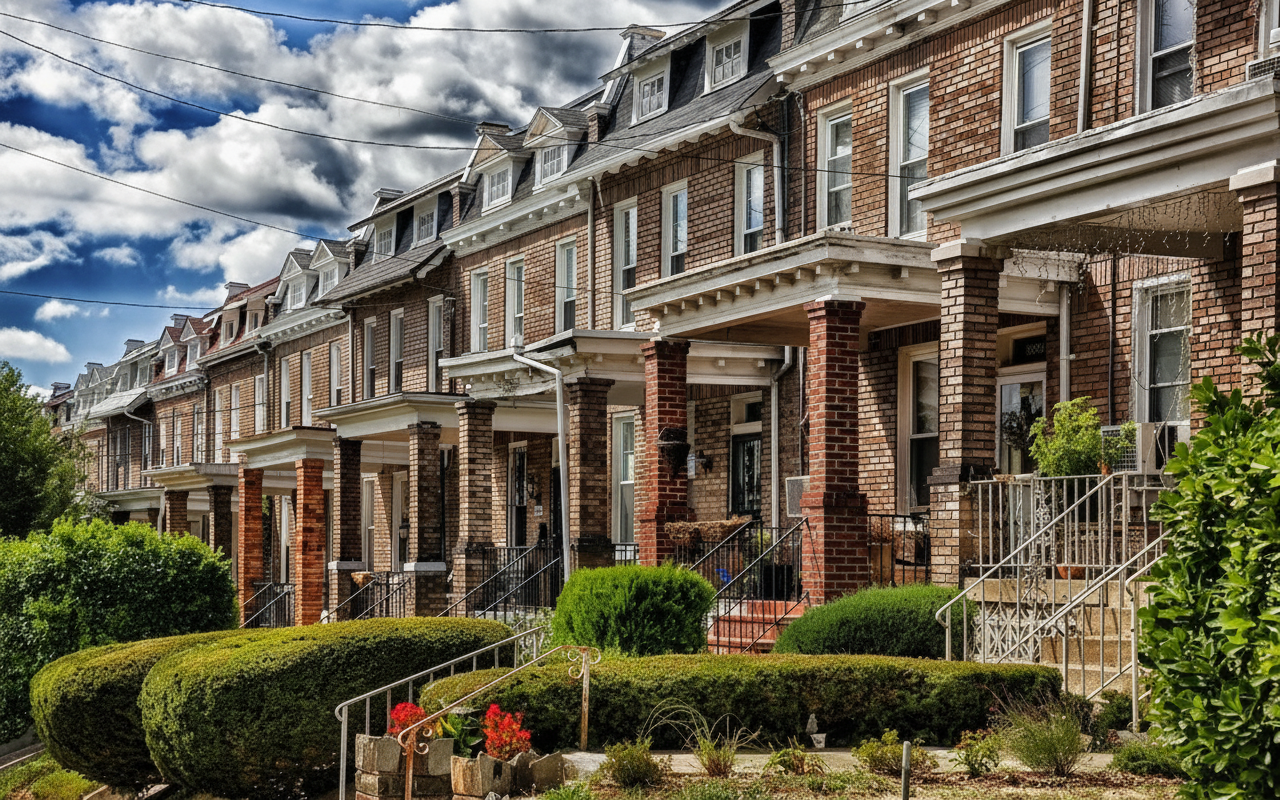
It's a largely residential neighborhood in upper Northwest (ZIP 20011, Ward 4), and one of the first parts of the city that was deliberately planned. It was platted in 1889 on the old Tayloe estate, with a street grid threaded by two traffic circles and diagonal avenues. The result is blocks of early-1900s brick rowhouses with deep front porches, anchored by Grant Circle and Sherman Circle, which act as the neighborhood's communal front yards.
What you give up, compared to denser neighborhoods to the south, is a little bit of walk-out-the-door retail. What you get back is space, porches, and quiet, without leaving the city.
What makes Petworth, Petworth
The defining home here is the "Wardman" rowhouse: an efficient brick rowhouse with a deep front porch, built mostly in the early 1900s, usually with multiple levels, a basement, and a rear yard. You'll also find Craftsman bungalows and colonials, plus a growing layer of condo conversions and small condo buildings, mostly closer to Georgia Avenue.
The two circles drive the culture. People stoop-sit, wave, and actually know their neighbors. The free Petworth Jazz Project plays in the circles in summer, and Petworth Porchfest turns the neighborhood into a music festival. In 2025, roughly 300 bands played about 130 porches.
There are two commercial spines. Georgia Avenue is the main one, with larger retail, grocery, and the Metro. Upshur Street is the compact, independent restaurant-and-retail row that the Washington Post once called "the best place to eat in DC right now."
What are the best pockets of Petworth to buy in?
Most guides stop at "work with a local agent who knows the blocks." Here's the local part. Petworth isn't one feel. It's four.
- Grant Circle is the grand center of the original plan and a historic district. You're buying the classic Petworth rowhouse on a signature address, with real architectural continuity. Best for buyers who want the postcard version of the neighborhood and a strong sense of place.
- Sherman Circle, just northwest, is quieter and more purely residential. Same rowhouse heart of Petworth, calmer street life. Best for buyers who want settled and low-key.
- The Upshur Street corridor puts you walking distance to dinner. If a true neighborhood Main Street matters more to you than square footage, this is the pocket.
- Georgia Avenue and the Metro is the most transit-first, lowest-maintenance part of the neighborhood, with more condos and apartments above retail, and you can step out the door onto the Green or Yellow Line. Best for commuters and condo buyers.
When you tour with us, this is the first thing we sort out: which of these four pockets actually fits how you live. It changes which listings are worth your Saturday.
What are the best neighborhoods around Petworth (and how do you choose)?
If Petworth is tight on budget or you need something it doesn't have, you don't have to leave the area. You just shift a few blocks. Four neighbors each solve a different problem, and here's how they stack up against Petworth.
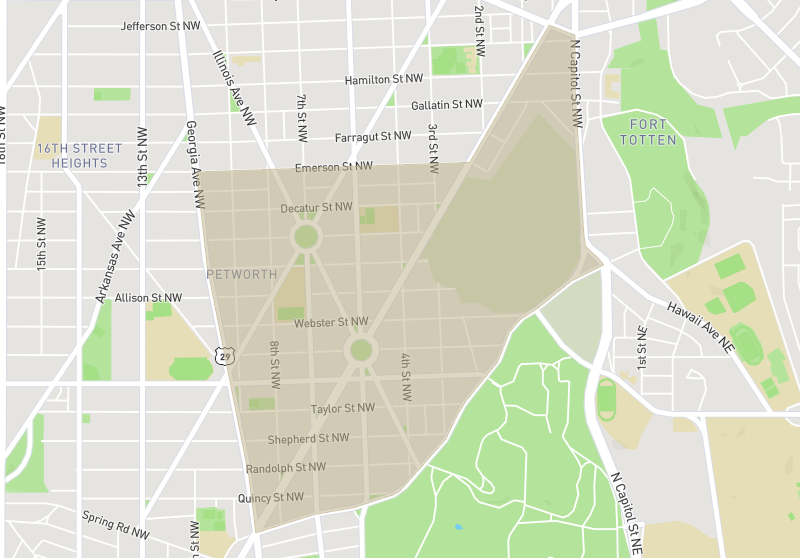
Park View, just to the south, shares Petworth's Wardman rowhouse stock (most of it built between 1900 and 1930) but sits a notch closer to the center, near Howard University and Columbia Heights. It often feels a touch more central, tends to run a bit lower than Petworth on price, and is popular with first-time buyers and young couples. Locals will tell you flatly, though: "Park View is not Petworth." It's its own neighborhood.
Columbia Heights, also to the south, is the trade you make when you want walkable amenities and transit over quiet: its own Metro, big-box and chain retail, and a lively 14th Street and Park Road core. Housing runs from condos and apartments to rowhouses, usually at a lower median than Petworth but in smaller footprints. Best for buyers who want everything at the doorstep.
16th Street Heights, to the west, is the sleeper. An old developer's covenant pushed detached single-family homes, so you get grand colonials, Tudors, and Craftsmans set back on leafy, tree-lined streets, with more space and quiet. It's the premium single-family pocket of the group and usually prices higher than Petworth. Best for buyers who want a detached house and a yard.
Brightwood, up Georgia Avenue toward the Maryland line, is the affordable foothold: roughly 1,500 early-1900s rowhouses, plenty with renovation upside, near Fort Stevens and Rock Creek Park. It's typically the lowest entry point of the group, which makes it a favorite of value buyers, first-timers, and renovators.
What does your budget actually buy in and around Petworth?
This is where most guides go vague. We'd rather give you a real read.
Pinning down one "Petworth price" is genuinely hard, because it depends on what you measure. The typical home value sits in roughly the $650,000s to $730,000s, while the median home that actually sold over the last few months ran higher, into the low $800,000s, pulled up by a handful of larger, renovated sales. Homes were going under contract in about a month, at roughly 97% of list price. These figures move quarter to quarter, so before you set a budget, ask us for this month's actual numbers on the blocks you're targeting.
Here's how we'd frame the tiers for a buyer:
- Entry or condo tier: a one- or two-bedroom condo near Georgia Avenue and the Metro. Lowest maintenance, lowest entry price, most transit-first.
- Classic rowhouse tier: a Wardman rowhouse in the heart of Petworth, with a porch, levels, a yard, and often an English basement.
- Space tier: a detached single-family home in 16th Street Heights, or a fully renovated rowhouse with parking.
- Value tier: a rowhouse in Brightwood with renovation upside, if you're willing to put in work for a lower entry point.
The right tier depends on whether you're optimizing for monthly cost, square footage, or location, and that's the conversation we'd rather have with you directly than guess at in a blog post.
Should you buy a condo or a rowhouse in Petworth?
A lot of buyers come in assuming a Petworth rowhouse is out of reach, then learn about the English basement. Many of these rowhouses have a separate lower-level apartment with its own entrance. Rent it out, and the income offsets a real chunk of your mortgage, which is how plenty of first-time buyers afford a whole rowhouse here instead of a condo.
The math is specific to the house, the unit, and DC's rules on basement apartments. A legal, separately metered unit with a certificate of occupancy rents for more than an unpermitted one. In this area a basement apartment commonly rents somewhere in the $1,600 to $2,000-plus a month range depending on size and whether it's a legal unit. That's real money against a mortgage. If you're weighing condo versus rowhouse, this is worth running real numbers on; it often changes the answer. We can model it together.
How do you get around in Petworth?
The anchor is the Georgia Avenue-Petworth Metro on the Green and Yellow Lines, sitting right where Petworth, 16th Street Heights, and Park View meet. From there it's roughly a 15 to 20 minute ride to downtown or the Waterfront.
Buses are strong too: the 70 and 79 run the length of Georgia Avenue, and the S-line buses run 16th Street toward K Street and the White House area. There are Capital Bikeshare stations and bike lanes throughout, with Rock Creek Park close by. Near the Metro, plenty of residents skip a car entirely; deeper into the residential blocks around the circles, a car is easier to keep.
Is Petworth safe?
We'll give you the honest version, because that's what we'd want. Petworth sits in the police department's Fourth District (its core falls in Police Service Areas 404 and 407), and like the rest of DC it's at or near multi-decade crime lows. Citywide crime is down sharply in 2026, with car thefts and car break-ins down roughly 30% to 56% year over year.
Here's the honest part most guides skip: the realistic, day-to-day concern in Petworth is property crime (car break-ins and packages taken off the porch), not violent crime, which is comparatively uncommon here (mostly robbery, and more on the Georgia Avenue nightlife strip late at night). Around nine in ten reported incidents are property crime, and, as of early summer 2026, the core service areas had recorded no homicides this year.
The practical moves are the same ones long-time neighbors make: never leave anything visible in a parked car, put up a video doorbell (DC even runs a Security Camera Rebate Program that reimburses residents), and stay normally aware on the Georgia Avenue corridor at night. Before you commit to a specific block, pull the current, block-level numbers yourself on MPD's Crime Cards (crimecards.dc.gov). Small-area data moves, and we'd rather you see the real picture for your address than trust a neighborhood average. Tell us the blocks you're weighing and we'll walk through them with you.
What schools serve Petworth?
For families, this is the section most agent guides skip. In DC, every address has a guaranteed in-boundary (by-right) elementary, middle, and high school, and in Petworth the in-boundary elementary depends on your exact block. Much of the Petworth core is zoned to Powell Elementary (a dual-language school right on Upshur Street), while surrounding blocks fall to Truesdell, Barnard, or John Lewis (the rebuilt school formerly known as West). From there the Petworth feeder runs to MacFarland Middle School and Roosevelt High School for most of the neighborhood. DC redraws these boundaries from time to time, so confirm the exact in-boundary schools for any specific address.
You're not locked to your boundary school, though. DC runs a single common lottery through My School DC: one application lets you apply out-of-boundary and to public charters. There are strong charters in and around Petworth, including the Petworth campus of Center City PCS (right in the neighborhood), E.L. Haynes, LAMB, and Washington Latin. In-boundary gets you a guaranteed seat; the lottery is how you reach the rest. If schools are driving your search, we should map your specific addresses against current boundaries and charter options before you fall for a house.
What first-time buyer help is available in DC?
Most buyers don't know how much help exists, and it can be the difference between renting and owning here. A few of the big ones, for eligible buyers:
- HPAP (the Home Purchase Assistance Program) offers first-time DC buyers up to $202,000 in interest-free, deferred down-payment assistance, plus up to $4,000 toward closing costs.
- DC Open Doors pairs a below-market first mortgage with a deferred, 0%-interest down-payment loan, and it's open to repeat buyers, not just first-timers.
- EAHP helps DC government employees with a deferred loan plus a matching grant toward down payment and closing costs.
- A reduced recordation tax (0.725%, versus the standard rate) lowers what eligible first-time buyers pay at closing.
These limits and caps reset every year, so confirm the current figures with a lender or DCHFA. This is something we handle a lot on the buy side: most buyers don't realize these programs exist until we walk them through it, and that's exactly the part we're built to do.
Frequently asked questions about buying in Petworth
Is Petworth a good neighborhood to buy a home in?
What kind of homes does Petworth have, a rowhouse or a condo?
What's the difference between Petworth and Park View?
How far is Petworth from downtown, and what Metro serves it?
Is it better to buy a condo or a rowhouse in Petworth?
What first-time buyer programs apply in Petworth?
About the author

Marc Dosik, Fed City Team at Real Broker LLC
Marc is the Associate Broker and primary decision-maker for Fed City Team. He has lived in the Washington, DC metro area his whole life and has been a licensed broker since 1998. He knows the DC market and specializes in contracts, negotiation, grant programs for home buyers, short sales and foreclosures, and 1031 exchanges. His office is on Upshur Street in the middle of Petworth, and the team works across DC, Maryland, and Virginia.
Thinking about buying in or around Petworth? Start your home search with Marc today, or reach the team at (202) 543-7283 or [email protected].
Explore neighborhoods: Petworth · Columbia Heights · all DC areas. Buying for the first time? See Buy a Home.
Disclaimer: Real estate prices, public down-payment and tax programs, school boundaries, rental income and the legal or rentable status of basement units, and crime statistics referenced here change frequently and vary by address. This article is general information, not financial, legal, tax, or investment advice. Confirm current figures, eligibility, boundaries, and rental-licensing rules with the relevant DC agency or a licensed professional before making any decisions.
Check out this article next