By Marc Dosik, a real estate broker licensed in DC, Maryland, and Virginia (Fed City Team at Real Broker LLC), with an office at 843 Upshur Street NW in Petworth, Washington DC.
The short answer: if you want to live in the cultural heart of DC, walk to two Metro stations, and choose between a century-old rowhouse and brand-new condo construction on the same block, Shaw is one of the most central and energetic places you can buy in the city. It's denser, more nightlife-forward, and generally pricier than the neighborhoods to the north, and it rewards buyers who know which of its blocks fits how they actually live. Below is how we would help you decide.
Marc Dosik has sold real estate across DC, Maryland, and Virginia since 1998, and Fed City Team runs its office at 843 Upshur Street NW in Petworth, a straight shot up Georgia Avenue and 7th Street from Shaw. The team has closed 1,500+ transactions, including over 130 short sales, so the harder Shaw deals (estate sales, title knots, and new-construction condo contracts) are familiar ground. This is the same walkthrough we give buyers who sit down with us.
Disclaimer: Real estate prices, public down-payment and tax programs, school boundaries, transit routes, and the legal status of condo conversions referenced here change frequently and vary by address. This article is general information, not financial, legal, tax, or investment advice. Confirm current figures, eligibility, boundaries, and licensing rules with the relevant DC agency or a licensed professional before making any decisions.
Is Shaw a good place to buy a home?
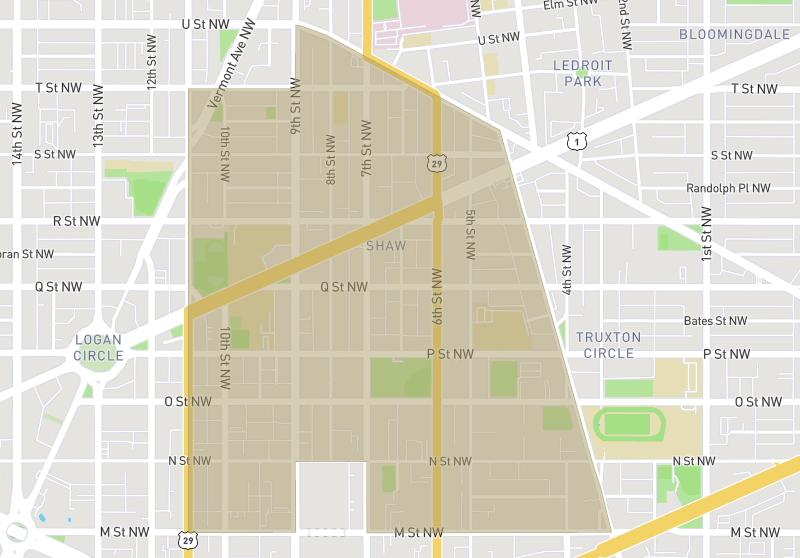
For a lot of buyers, yes, as long as you want to be in the middle of everything. Shaw sits in Northwest DC (ZIP 20001), now consolidated entirely within Ward 2 after the 2022 redistricting (it was historically split between Wards 2 and 6), and at under a square mile it is one of the densest neighborhoods in the city. What you trade for that central location is space and quiet. Shaw is busier and noisier than Petworth or 16th Street Heights, and you generally pay more per square foot. What you get back is being a few minutes by Metro from Gallery Place, surrounded by restaurants, live music, and history, with a wider range of home types than almost anywhere else in DC. For buyers who want to be at the center of city life, that trade is the whole point.What is Shaw, DC known for?
Shaw's identity is rooted in being the historic center of Black life in Washington. The neighborhood is named for Shaw Junior High, itself named for Robert Gould Shaw, the Union colonel who led the 54th Massachusetts Infantry, one of the first African American units of the Civil War. The name was applied in the late 1960s, through the Shaw School Urban Renewal Area; before that the area was known as Midcity, or Uptown. From the 1920s through the 1950s, U Street was "Black Broadway," the cultural and commercial center of Black life in the city. Duke Ellington grew up on T Street. Langston Hughes, Zora Neale Hurston, Carter G. Woodson, and Thurgood Marshall all lived or worked here, and Howard University (founded 1867) still anchors the north edge. The Howard Theatre, which opened in 1910, was the first large theater in the country built for Black audiences and hosted everyone from Ellington to Ella Fitzgerald to James Brown. The April 1968 riots after the assassination of Dr. King devastated the U Street and Shaw commercial corridor, and decades of vacancy and decline followed. The turnaround markers are clear: the U Street Metro opened in 1991, a full-scale renaissance took hold in the mid-2000s, and the Howard Theatre reopened in 2012 after a $29 million restoration. Around 9th and U, Ethiopian-owned businesses have clustered since the 1980s, and the DC Council ceremonially recognized "Little Ethiopia" in 2020. It is worth being honest about what that turnaround has meant. Longtime Black homeowners, many of them multi-generational, live alongside newer arrivals, and that mix creates real energy as well as real tension around affordability and displacement. Gentrification in Shaw is an ongoing process, not a finished one, and it has been underway for more than twenty years. We think buyers should understand the neighborhood they are joining.What kind of homes does Shaw have?
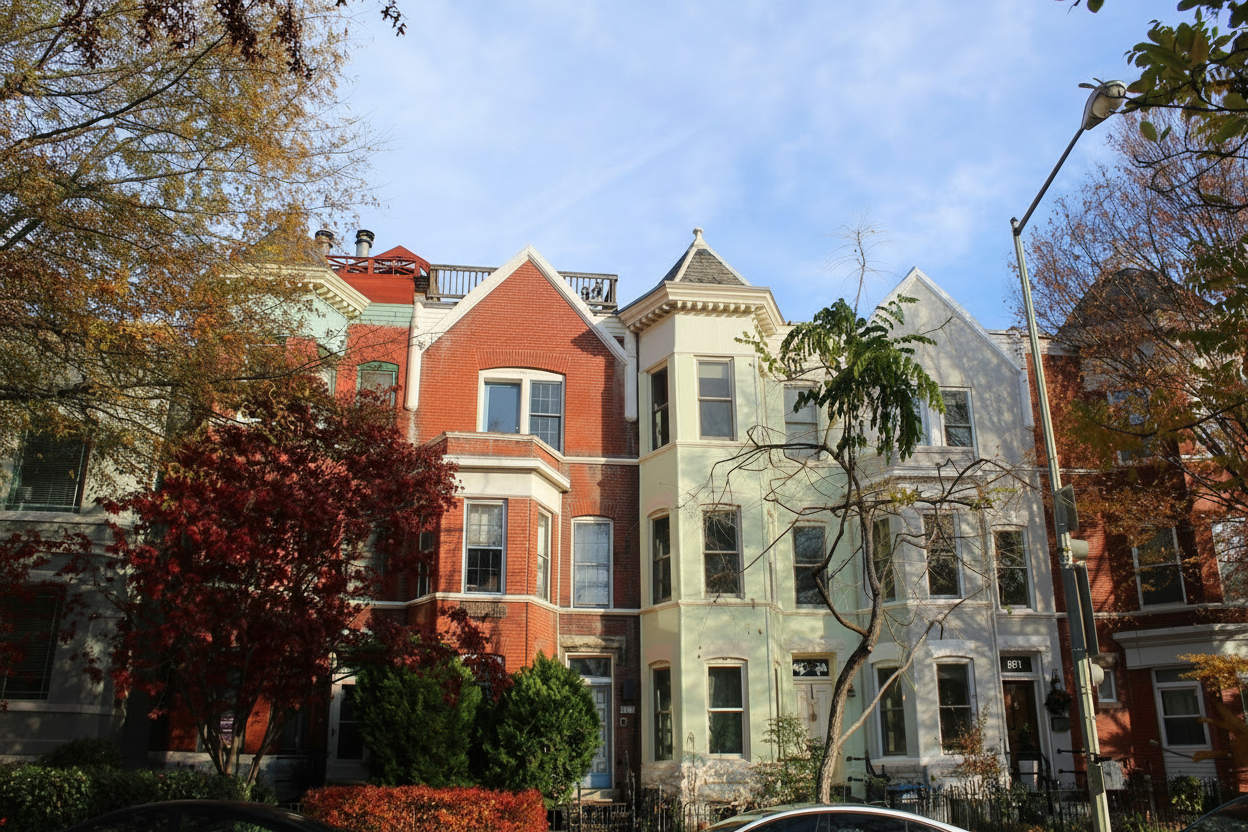
Three very different kinds, often on the same block. The backbone is the rowhouse: two to three stories of brick, built mostly between the 1880s and the 1920s, ranging from modest two-bedroom workers' cottages to larger three- and four-bedroom homes with high ceilings and ornate detail. Most are late-19th and early-20th-century rowhouses, and the Wardman-style rowhouse is the regional vernacular you will recognize from Petworth and Columbia Heights too. The second type is the "pop-top," a rowhouse with a full third or fourth story added, often subdivided into two or three condo units. Pop-tops are a common entry point to ownership in Shaw, but quality varies widely, so a thorough inspection and a careful read of the condo documents matter a lot. The third type is what really sets Shaw apart from Petworth: heavy new-construction condo and apartment product. Named buildings like Atlantic Plumbing, City Market at O (on the historic O Street Market site), and The Shay have added hundreds of units. North of the Convention Center you will find urban-renewal-era low-rise apartments alongside late-2010s mixed-use development, while 7th and 9th Streets, the historic commercial spines, are still lined with small businesses in rowhouse-sized buildings. The Blagden Alley and Naylor Court Historic District, once light-industrial alley buildings, now holds restaurants and cafes, including the Michelin-starred Dabney. Much of Shaw is a designated historic district.What are the different parts of Shaw, block by block?
Shaw is not one feel. It changes block by block, and which part you choose matters more here than in most neighborhoods. Here is how we break it down for buyers.
- The U Street Corridor, or West Shaw, runs roughly from 9th Street west to 14th Street. It is the most restaurant- and nightlife-dense part of the neighborhood, with condos in newer buildings and walking access to both the U Street and Shaw-Howard Metros. It is also the noisiest part on weekend nights, which is the trade-off for being in the middle of the action.
- Residential Shaw, east of 7th Street, is quieter and more purely residential, with more rowhouses (both renovated and original), generally lower prices than West Shaw, and more families and longtime owners. Shaw-Howard U is the main Metro here.
- The Convention Center and North Shaw area, around Mount Vernon Square, is built around larger condo buildings, hotels, and mixed-use development. Toward Florida Avenue, Howard University brings younger, campus energy. This stretch tends to be more affordable than central Shaw and is walkable to Logan Circle.
What does it cost to buy a home in Shaw?
Plan on a wide range, from the low $300,000s for a small condo to well over $1 million for a renovated rowhouse. Because Shaw mixes so many home types, no single median tells the real story. Here is how we frame the tiers for a buyer:- New-construction and converted condos: roughly $300,000 for a studio up to $850,000 and above for a two-bedroom, with the occasional penthouse over $1 million.
- Pop-top condo conversions: roughly $400,000 to $750,000.
- Renovated rowhouses: roughly $800,000 to $1.8 million, depending on size, condition, and block.
- Across all property types, recent sales have spanned the mid-$500,000s into seven figures.
How do you get around in Shaw?
Shaw is one of the best-connected neighborhoods in the city, with two Metro stations of its own. Shaw-Howard U, at 8th and R, serves the eastern half, and U Street/Cardozo, at 13th and U, serves the western half. Both sit on the Green and Yellow lines, a quick ride to Gallery Place and Chinatown (two stops from Shaw-Howard U, three from U Street). Depending on how you draw the boundary, the Mount Vernon Square and Convention Center station (also Green and Yellow) sits at the south edge, so parts of Shaw are within reach of two to three stations. Buses are strong too. The 7th Street routes connect Shaw to the Waterfront and up to Silver Spring, and a crosstown route links Georgetown University and Howard. WMATA redesigned and renamed its bus network in 2025, so confirm the current route numbers before you rely on a specific one. On foot, Shaw earns an excellent transit rating (a Walk Score transit score of 83 as of 2026). The White House is about a 10-minute trip by transit, Reagan National is roughly 25 to 35 minutes by car, and Dulles is roughly 40 to 55 minutes depending on traffic. Near the stations, plenty of residents skip a car entirely.What is there to do in Shaw?
Plenty, and most of it is on foot: food, live music, and history within a few blocks. The U Street row alone includes Ben's Chili Bowl (a genuine landmark), Compass Rose, and Marvin, with the Michelin-starred Dabney tucked into Blagden Alley a few blocks south. The 7th Street corridor adds Convivial, Tiger Fork, and All-Purpose Pizzeria, and Compass Coffee got its start right here in Shaw. Groceries are easy: a Whole Foods at P and 14th, a Giant inside the historic O Street Market at City Market at O, and a Trader Joe's at 14th and U. For music and culture, the 9:30 Club is consistently ranked among the best live-music venues in the country, the restored Howard Theatre is a few blocks away, and the African American Civil War Memorial and Museum sits right at the U Street Metro. One honest note: Shaw is dense, so its green space is pocket-park scale (Shaw Park, the Shaw Dog Park, Kennedy Recreation Center) rather than the Rock Creek Park access and big circles you get up in Petworth.How does Shaw compare to Petworth and Columbia Heights?
Shaw is the most central and nightlife-forward of the three. Petworth trades that for space and price, and Columbia Heights lands in between. Compared with Petworth, Shaw is more central (a few minutes to Gallery Place versus a 15- to 20-minute ride), denser, and home to far more new-construction condos, and it runs higher on renovated rowhouses (roughly $800,000 to $1.8 million versus Petworth's roughly $600,000 to $900,000 and up). Petworth gives you porches, quiet, Grant Circle and Sherman Circle, Rock Creek Park nearby, and more space for the dollar. If that sounds like the better fit, our Petworth buyer's guide walks through it in detail. Compared with Columbia Heights, which borders Shaw to the northwest, both neighborhoods are dense and transit-rich. Shaw has the higher renovated-rowhouse ceiling and leans more toward nightlife and Michelin dining, while Columbia Heights leads on big-box retail (a Target and the DC USA mall) and is a touch closer-in on price. Our Columbia Heights buyer's guide covers that one block by block.What schools serve Shaw?
In DC, your schools depend on your exact address, and Shaw's boundaries are actively changing, so confirm before you buy. DC Public Schools operates the public schools, and assignment is by address, not by neighborhood, so the right move is the official DCPS "Find Your In-Boundary School" lookup. For the 2025 to 2026 school year, the in-boundary elementary for Shaw blocks is typically Seaton, Garrison, or Cleveland, depending on the block. The middle-school picture is in active transition: students from Cleveland, Garrison, and Seaton currently have in-boundary rights to John Francis Education Campus for 6th grade and Cardozo Education Campus for 7th grade. A new middle school is funded for the former Banneker High School building at 800 Euclid Street NW, slated to open in August 2028, and those three elementaries are set to feed it. For the western and central blocks (the Seaton, Garrison, and Cleveland area), the in-boundary high school is Cardozo Education Campus, while Dunbar High School in Truxton Circle serves eastern Shaw. Because these boundaries and feeder patterns are changing, confirm the assignment for your specific address on the DCPS lookup before you commit to a block.What should buyers know before they buy in Shaw?
Know which of Shaw's three home types you are buying, because each one carries different costs and risks. After more than twenty years of sustained redevelopment and hundreds of new condo units, a buyer here is usually choosing between a century-old rowhouse, a pop-top conversion, and new-construction condo. Each has its own inspection concerns, HOA structure, and long-term maintenance picture, and the right questions are different for each. Estate sales and title complications are also common in Shaw, because so many rowhouses have stayed in the same families for generations. Fed City Team has closed many of these, which ties directly to our experience with more than 130 short sales and estate-sale work. And for first-time buyers, this is where DC's down payment assistance programs can be the difference between renting and owning: the team helps eligible buyers access DC down payment and closing-cost assistance. Most buyers don't realize these programs exist until we walk them through it, and that's exactly the part we're built to do.Frequently asked questions about buying in Shaw
What's the price range to buy a home in Shaw?
It's wide, because Shaw mixes so many home types. Small condos start in the low $300,000s, pop-top conversions run roughly $400,000 to $750,000, and renovated rowhouses run roughly $800,000 to $1.8 million. Across all property types, recent sales have spanned the mid-$500,000s into seven figures. Ask us for this month's actual numbers before you set a budget.
Is Shaw a good neighborhood for first-time buyers?
It can be. Studios and one-bedroom condos starting in the low $300,000s are a realistic entry point, and you're walking distance to two Metro stations. We also help first-time buyers tap DC down payment assistance, which can cover a meaningful part of the upfront cost.
Which Metro stations serve Shaw?
Two of its own, both on the Green and Yellow lines: Shaw-Howard U at 8th and R serves the eastern half, and U Street/Cardozo at 13th and U serves the western half. Shaw-Howard U is two stops from Gallery Place and U Street is three. Depending on the boundary, the Mount Vernon Square station sits at the south edge too.
How loud is the nightlife in Shaw?
It depends on the block. The U Street and 14th Street blocks hear the bars and music venues on weekend nights. Move one or two blocks into the residential streets and it drops off sharply. We can steer you toward quieter blocks if that matters to you.
Are Shaw's rowhouse and pop-top condo conversions a good buy?
They can be, but quality varies a lot. A pop-top is a rowhouse with a full upper story added and often split into two or three condos, which makes for a lower entry price. Always get a thorough inspection and read the condo documents closely before you commit.
Which schools are in-boundary for Shaw addresses?
DC assigns schools by exact address, not neighborhood, and Shaw's boundaries are changing. In-boundary elementary is typically Seaton, Garrison, or Cleveland depending on the block, the high school is Cardozo for western and central Shaw and Dunbar for the Truxton Circle blocks to the east, and a new middle school is slated to open in the former Banneker building in 2028. Confirm your address on the DCPS in-boundary lookup.
About the author
Marc Dosik, Fed City Team at Real Broker LLC
Marc is the Associate Broker who leads Fed City Team. He has lived in the Washington, DC metro area his whole life and has been a licensed broker since 1998. He knows the DC market and specializes in contracts, negotiation, grant programs for home buyers, short sales and foreclosures, and 1031 exchanges. His office is on Upshur Street in Petworth, and the team works across DC, Maryland, and Virginia.
Thinking about buying in Shaw or anywhere in DC? Start your home search with Marc today, or reach the team at (202) 543-7283 or [email protected].
Explore neighborhoods: Shaw · Petworth · Columbia Heights. Buying for the first time? See Buy a Home.
Disclaimer: Real estate prices, public down-payment and tax programs, school boundaries, transit routes, and the legal status of condo conversions referenced here change frequently and vary by address. This article is general information, not financial, legal, tax, or investment advice. Confirm current figures, eligibility, boundaries, and licensing rules with the relevant DC agency or a licensed professional before making any decisions.
Check out this article next