By Marc Dosik, a real estate broker licensed in DC, Maryland, and Virginia (Fed City Team at Real Broker LLC), with an office at 843 Upshur Street NW in Petworth, Washington DC.
The short answer: before selling an inherited house in Silver Spring, confirm who has authority to sign for the estate, then compare three paths using the same facts: an open-market as-is listing, a prepared open-market listing, and a direct offer. The strongest choice is usually the one that produces the best reasonable net result after cost, carrying time, uncertainty, and the property's condition are considered together.
That answer can change from one Silver Spring property to the next. A downtown condo may turn on association documents and assessments. A detached postwar home may turn on older systems, active damage, cleanout, and whether a limited preparation plan would broaden the buyer pool. Start with the property and the numbers, not a rule that every inherited home should be renovated or sold quickly.
Maryland legal, regulatory, and government sources were last verified August 12, 2026.
What should you do first after inheriting a Silver Spring home?
Do not start with a dumpster or a contractor. Start by confirming authority and protecting the property.
- Confirm who can act for the estate. Maryland calls the court-appointed fiduciary the personal representative, often referred to as the executor or administrator. Maryland Courts explains that the Register of Wills or Orphans' Court appoints that person. The Register provides Letters of Administration showing the appointment. A will by itself does not confirm that someone can sign a listing agreement or sale contract.
- Confirm whether the house is actually a probate asset. Maryland's Register of Wills distinguishes property owned solely by the decedent or as a tenant in common from property that may pass outside probate through survivorship, a trust, or a beneficiary arrangement. Ask the estate attorney and title company to review the deed, governing documents, Letters, will, and any court orders before the estate commits to a sale path.
- Secure the home and contact the insurer. Keep necessary utilities operating, control access, document the condition, and tell the insurance carrier if the property is vacant or unoccupied. The Maryland Insurance Administration cautions that vacancy can affect homeowners coverage, so do not assume the existing policy remains unchanged.
- Preserve records and personal property before cleanout. Separate important papers, valuables, items named in the will, and anything the personal representative or appraiser may need before belongings are sold, donated, or discarded.
- Get a property assessment before committing money. The first real estate analysis should be side-by-side sale paths with a supported price range, preparation scope, timing, carrying-cost assumptions, and risks.
Silver Spring is an unincorporated part of Montgomery County, so there is no separate Silver Spring city probate or permit office. For a Maryland resident, the proper Register of Wills generally depends on where the decedent was domiciled, not simply where the house is located. Maryland law has a separate venue rule for a nonresident, and a foreign personal representative may need a Maryland ancillary proceeding. If Montgomery County is the correct jurisdiction, its Register of Wills office is in Rockville.
What type of Silver Spring property did the estate leave behind?
Silver Spring is not one uniform housing market. Montgomery Planning describes an urban downtown surrounded by residential neighborhoods, and its housing research documents detached homes, attached homes, condominiums, and small multifamily buildings in and around the plan area. Those differences affect what buyers expect and which preparation work can matter.
| Property situation | Questions to answer before choosing a sale path |
|---|---|
| Downtown condo or cooperative | Are association documents current? Are there pending assessments, move rules, access procedures, storage or parking rights, or unit conditions that affect the likely buyer? |
| Detached postwar home | Are the roof, drainage, electrical, plumbing, HVAC, windows, or foundation creating active damage, safety concerns, or financing friction? Would cleaning and a limited presentation scope change how the home competes? |
| Attached home or townhome | Which exterior elements belong to the owner, and which belong to an association? Are there resale-package, fee, insurance, or approval requirements to address before launch? |
| Small multifamily or occupied property | What leases, deposits, notices, licenses, access rules, and tenant rights apply? Coordinate with Maryland counsel before setting a timeline or marketing plan. |
| Historic or specially regulated property | Is the individual property designated or located in a regulated district? Montgomery County says substantive exterior changes to designated historic resources may require a Historic Area Work Permit in addition to ordinary permits. |
Use Fed City Team's Silver Spring real estate guide for the broader local market context. For this decision, the important point is simple: the same repair budget can have a different effect depending on the property type, submarket, competing inventory, and likely buyer.
Which of the three selling paths fits the estate?
The three common paths are not interchangeable. Compare each against the estate's actual authority, deadlines, funds, and risk tolerance.
| Path | Strongest fit | Work before launch | Buyer exposure | Main tradeoff |
|---|---|---|---|---|
| Open-market as-is listing | The property can be shown safely, the estate wants broad market exposure, and major preparation is not supported by the likely return or timeline | Secure the home, complete necessary cleanout, document condition, make it presentable, and prepare required transaction materials | Broad, although condition and financing may narrow the buyer pool | Buyers may discount for uncertainty or request terms that shift condition risk back to the estate |
| Prepared open-market listing | A defined set of work is likely to improve presentation, buyer confidence, financeability, or expected net proceeds enough to justify the cost and time | Complete only an approved scope supported by current comparable sales, contractor estimates, and a realistic schedule | Often broader if the work removes meaningful buyer objections | The estate takes on execution, delay, overrun, and carrying-cost risk |
| Direct offer | The estate values speed, simplicity, limited showings, or minimal preparation enough to consider narrower exposure | Usually limited, but verify the buyer, proof of funds, contract terms, assignment rights, contingencies, and closing capacity | One buyer or a small private pool | Convenience may come with a lower price or less competitive tension |
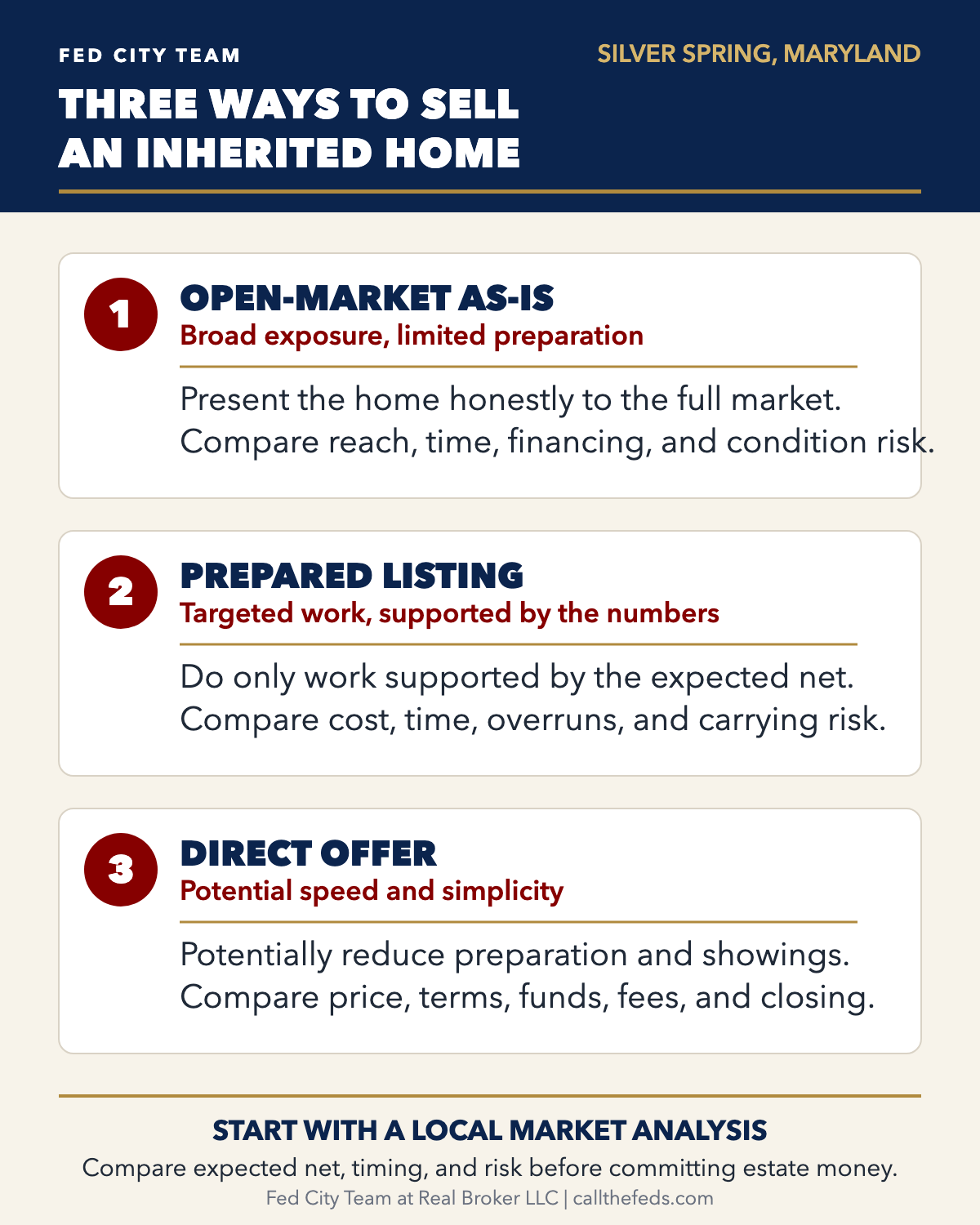
An as-is listing is not the same as a direct cash offer. An as-is listing can still expose the home to the full market, and it does not automatically eliminate inspections, financing, disclosures, or contract negotiation. A direct offer limits the comparison to one buyer's price and terms unless the estate obtains competing offers.
Which repairs deserve consideration before a Silver Spring listing?
Start with work that changes the decision, not work that merely makes a long list.
First: active damage, safety, and function
Investigate leaks, moisture, unsafe electrical conditions, failed major systems, structural concerns, access hazards, and anything that may keep the property from being insured, shown safely, or financed. A qualified inspector and contractor should define the condition and scope. Montgomery County advises owners to check permit requirements before work begins because structural, electrical, HVAC, and other projects may require permits.
Second: cleanout and buyer confidence
A controlled cleanout, deep cleaning, yard work, simple lighting corrections, touch-up paint, and minor repairs can help buyers understand the home without hiding its condition. The goal is not to erase every sign of age. It is to remove avoidable friction and let the property present honestly.
Third: targeted market preparation
Larger work should be tied to current comparable sales and a written net analysis. A kitchen renovation, bathroom project, window replacement, or full cosmetic update should not be approved because someone says it will "pay for itself." Ask which buyer objection the work removes, what price or terms it may affect, how long it will take, and what happens if the scope grows.
For housing built before 1978, federal lead-disclosure rules can still apply. The Environmental Protection Agency says sellers generally must disclose known lead information and available records, provide the federal pamphlet and contract language, and give the buyer an opportunity for a lead inspection or risk assessment. Maryland's fiduciary-transfer exception to the standard state disclosure or disclaimer form should not be described as an exemption from every other disclosure, contract, federal, or licensee obligation.
How should the estate compare the numbers?
Do not decide from the highest projected sale price. Build a written comparison using the same categories for each path. The blanks below are an estate worksheet, not published estimates.
| Decision input | Open-market as-is | Prepared listing | Direct offer |
|---|---|---|---|
| Supported sale-price or offer range | $_____ | $_____ | $_____ |
| Cleanout and preparation budget | $_____ | $_____ | $_____ |
| Expected carrying costs during the plan | $_____ | $_____ | $_____ |
| Selling and settlement cost assumptions | $_____ | $_____ | $_____ |
| Time range and key dependencies | _____ | _____ | _____ |
| Risk or contingency buffer | $_____ | $_____ | $_____ |
| Expected net range | $_____ | $_____ | $_____ |
The personal representative is a fiduciary. Maryland law requires estate administration to move forward reasonably promptly while avoiding an unreasonable sacrifice of value. That supports a documented comparison of net, time, and risk. It does not mean the estate must chase the highest theoretical price at any cost.
The estate may also need a date-of-death valuation for probate or tax work. That value is not automatically today's recommended list price. Keep the appraisal, tax basis, current market analysis, and final sale price in their proper roles, and ask the estate attorney or tax professional which valuation the estate needs.
What happens to the belongings inside the home?
The house and its contents are separate projects. An estate sale company, auctioneer, liquidator, donation service, or cleanout crew may handle personal property. A real estate broker handles the marketing and sale of the real property.
Before anything leaves the home, the personal representative should identify items governed by the will, preserve records and valuables, and confirm whether any property needs appraisal. Our guide to estate sale companies versus real estate brokers explains the handoff without confusing the two jobs.
How does Fed City Team handle an inherited Silver Spring home?
We start with the house and three side-by-side paths.
First, we assess how the property can compete in its current condition. Then we identify only the work that may change presentation, buyer confidence, financeability, or expected net proceeds. We compare that prepared plan with an open-market as-is launch and the terms of any credible direct offer.
Fed City Team can coordinate property access, cleanout and contractors, photography, marketing, showings, offer comparison, and the real estate side of settlement while the personal representative, attorney, and title company handle their respective authority and legal roles. Our regional estate-home sale process explains the broader service.
For qualifying homes, Fed City Team may advance approved preparation costs and be reimbursed from the sale proceeds at settlement. The scope, eligibility, budget, repayment terms, and plan if the home does not close must be agreed in writing before work begins. The current overview is on our Sell With Us page.
Before the estate commits money or time, ask Marc for a Silver Spring property assessment and three side-by-side net estimates: open-market as-is, prepared listing, and direct offer.
Frequently asked questions about selling an inherited house in Silver Spring
Can you sell an inherited house in Silver Spring before probate is complete?
Sometimes. The estate does not necessarily have to be fully closed before a sale, but the correct person must have authority to bind the estate. Maryland law gives an appointed personal representative broad authority to sell estate property unless the will, a court order, title, or the facts impose a limit. Ask the estate attorney and title company to confirm authority before listing or signing a contract.
Who can sign a Maryland listing agreement for an estate-owned home?
The person with confirmed authority for the property should sign in the correct representative capacity. In a Maryland probate estate, that is commonly the court-appointed personal representative holding Letters of Administration. Trusts, survivorship ownership, title disputes, multiple fiduciaries, and court restrictions can change the answer, so confirm the deed and estate documents first.
Should an inherited Silver Spring house be sold as-is?
It depends on the home's condition, likely buyer, timeline, available estate funds, and what current comparable sales support. Compare an open-market as-is listing, a defined preparation plan, and any direct offer using expected net proceeds, time, and risk rather than choosing from the list price alone.
Is a direct cash offer the same as an as-is listing?
No. A direct offer comes from one buyer and may reduce preparation or showings. An open-market as-is listing offers the home in its present condition to a wider buyer pool. Compare price, proof of funds, contingencies, assignment rights, fees, closing capacity, and the estate's timing before accepting either path.
Which repairs should an estate consider first in an older Silver Spring home?
Start with active damage, safety, major systems, access, and conditions that may affect insurance or financing. Then consider limited cleanout and presentation work. Approve larger renovations only when current comparable sales, written estimates, carrying costs, and a realistic schedule support the likely net benefit.
Can approved repair costs be paid from the sale proceeds?
For qualifying homes, Fed City Team may advance approved preparation costs and be reimbursed from sale proceeds at settlement. The scope, eligibility, budget, repayment terms, and plan if the property does not close must be agreed in writing before work starts.
What changes if the inherited property is a downtown Silver Spring condo?
The estate may need to address association documents, resale requirements, fees, assessments, insurance responsibilities, move rules, building access, parking, storage, and unit condition before launch. Review the governing documents and current association information early so they do not become last-minute surprises.

Disclaimer: Estate authority, title, fiduciary duties, disclosure obligations, permits, insurance, inspections, financing, taxes, repair decisions, contract rights, program eligibility, and closing requirements vary by property and estate and can change. This article is general information, not legal, tax, financial, lending, insurance, appraisal, construction, or investment advice. Confirm estate authority and transaction requirements with a Maryland attorney and title company, tax matters with a qualified tax professional, property condition with qualified inspectors and contractors, permit requirements with the proper agency, and insurance with the carrier. Exact Fed City Team preparation-program terms must be agreed in writing before work begins.
Check out this article next